
Preparing for the O-Level examinations can feel overwhelming, especially when multiple subjects compete for your time and attention.
A well-structured revision timetable is not just about planning what to study, but about studying smarter, staying consistent, and reducing last-minute stress.
This guide explains how to create a realistic and effective revision timetable for O-Level students in Singapore, based on proven study strategies.
How to Create Your O-Level Revision Timetable

Understand and Prioritise Your Revision
Before filling in any timetable, take time to understand what you actually need to revise.
Start by listing all your O-Level subjects and breaking each one down into topics based on the Singapore Examinations and Assessment Board (SEAB) syllabus.
Then, categorise each topic into one of three groups:
- Topics you are confident in
- Topics you understand but need practice
- Topics you struggle with
Tip: Always prioritise topics you are weaker in or have difficulty understanding. Many students spend too much time revising what feels comfortable, which gives a false sense of preparedness.
Use Topical Revision Strategically
Topical revision is a method of studying where you revise one syllabus topic at a time, instead of mixing different topics or doing full exam papers straight away.
Topical revision should form the foundation of your timetable, especially in the early stages.
Effective topical revision includes:
- Scanning and reading concise notes to understand key concepts
- Memorising definitions, processes, and formulas where required
- Practising topical questions to check understanding
Avoid passive reading alone. Active recall, such as answering questions without notes, is far more effective for long-term retention.
Schedule Regular Refreshers
One commonly overlooked best practice is revision spacing (also known as spaced revision). Revisiting topics regularly helps prevent forgetting.
Plan short refresher sessions every one to two weeks for topics you have already studied.
These sessions can include:
- Quick quizzes
- Mind maps
- Reviewing mistakes from previous practices
This approach strengthens memory and reduces the need for cramming closer to the exams.
Related: Recognising and Addressing Academic Burnout in O-Level Students: A Parent’s Guide
Include Past Papers and Revision Papers
Past-year papers are essential for O-Level preparation. They help you:
- Familiarise yourself with question formats
- Practise time management
- Identify recurring question types
Allocate specific slots in your timetable for full papers under timed conditions, especially in the final months before the examination.
Interested in our Small Group Tuition?
Our classes are led by Ms. Irene Liu, an educator with over 10 years of teaching experience and has authored assessment books now used in schools! She's helped countless students make dramatic grade improvements – from failing grades to A2s.
What Ms. Liu provides:
✅Standard answer booklet
✅Keywords training
✅High frequency questions training
✅Paper 3 practical exam training
✅Frequent topical tests and mock exams
WhatsApp UsTypes of Revision Timetables
There is no single revision timetable that works for every O-Level student. Different stages of revision require different timetable structures.
Using the right type of timetable at the right time helps students stay organised, consistent, and focused.
Monthly Revision Timetable
A monthly revision timetable provides a clear overview of your revision plan and is especially useful when preparing several months ahead.
When creating a monthly timetable:
- Include all commitments such as school hours, CCAs, tuition, family responsibilities, and rest days
- Schedule regular breaks and leisure activities to prevent burnout
- Clearly list the subjects and broad topics you plan to revise each week
This big-picture view helps ensure balanced coverage of all subjects and prevents weaker topics from being neglected.
Example of a Monthly Revision Table
Week | Main Focus | Subjects & Topics |
Week 1 | Content revision | Biology: Cell Structure & Movement Chemistry: Atomic Structure Maths: Algebra |
Week 2 | Content revision | Biology: Nutrition in Humans Chemistry: Acids & Bases Maths: Geometry |
Week 3 | Mixed revision | Biology: Transport in Plants Chemistry: Periodic Table Maths: Trigonometry |
Week 4 | Consolidation | Biology & Chemistry refreshersTopical practice questions |
Weekly Revision Timetable

A weekly revision timetable breaks the monthly plan into manageable daily study blocks.
It is particularly useful for:
- Balancing revision with daily school commitments
- Setting realistic and achievable goals
- Adjusting revision based on weekly progress
Weekly timetables form the core structure of most effective O-Level revision plans.
Example of a Weekly Revision Table
- Weekday (After School)
Time | Activity |
4.30 – 5.00 pm | Rest and snack |
5.00 – 6.00 pm | Biology – Weak topic (topical revision) |
6.00 – 6.15 pm | Break |
6.15 – 7.15 pm | Chemistry – Practice questions |
7.15 – 8.00 pm | Dinner |
8.00 – 8.45 pm | Maths – Short practice / corrections |
8.45 – 9.15 pm | Light revision / flashcards |
After 9.15 pm | Wind down |
Weekend
Time | Activity |
9.00 – 10.30 am | Biology – Full topic revision |
10.30 – 10.45 am | Break |
10.45 – 12.15 pm | Chemistry – Topical questions |
12.15 – 1.30 pm | Lunch |
1.30 – 3.00 pm | Past-year paper (timed) |
3.00 – 4.00 pm | Review mistakes |
Daily Revision Timetable
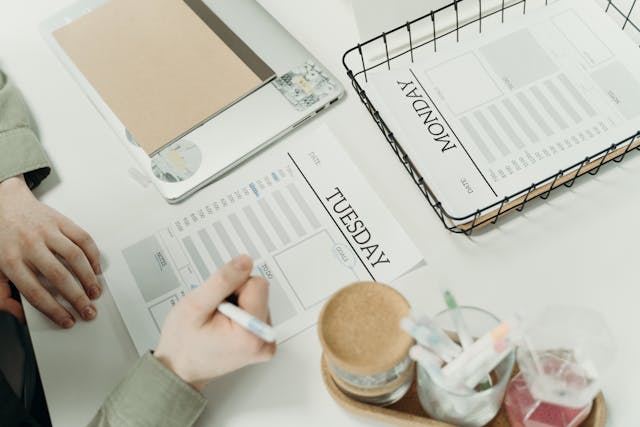
A daily revision timetable outlines specific tasks to be completed each day.
This type of timetable is useful:
- During intensive revision periods
- For students who prefer detailed structure
- When preparing close to examination dates
Daily planning helps reduce procrastination and improves focus by removing uncertainty about what to study.
Example of a Daily Revision Table
Time | Task |
9.00 – 10.00 am | Biology – Photosynthesis (notes + diagrams) |
10.00 – 10.15 am | Break |
10.15 – 11.15 am | Chemistry – Acids & Bases practice |
11.15 – 11.30 am | Break |
11.30 – 12.30 pm | Maths – Topical questions |
Afternoon | Rest / exercise |
4.00 – 5.00 pm | Review mistakes |
7.00 – 8.00 pm | Light revision / memorisation |
Tips When Creating Your Revision Timetable

Make Changes as You Go
A revision timetable is not meant to be fixed. Review it weekly and adjust based on:
- Your concentration levels
- Whether tasks take longer than expected
- Test results and teacher feedback
Flexibility ensures your timetable continues to work for you, rather than becoming a source of stress.
Related: 7 Strategies to Cope with Exam Stress
Use Different Approaches for Different Subjects
Not all subjects should be revised in the same way.
- Content-heavy subjects (e.g. Biology, Geography) benefit from diagrams, summaries, and active recall
- Calculation-based subjects (e.g. Mathematics, Physics) require frequent practice and error analysis
- Essay-based subjects (e.g. English, Humanities) need timed writing practice and feedback
Building variety into your timetable improves effectiveness and reduces boredom.
Related: The Irene Biology Method: How Our Exam-Focused Approach Differs from School Teaching
For Procrastinators: Try the Pomodoro Technique
If you struggle to start revision, the Pomodoro Technique can help. It involves:
- Studying for 25 minutes
- Taking a 5-minute break
- Repeating this cycle four times before a longer break
Short, focused sessions are often more productive than long, unfocused study blocks.
Additional Tips for O-Level Biology and Chemistry
For Biology:
- Focus on understanding processes rather than memorising blindly
- Practise drawing and labelling diagrams clearly
- Pay attention to command words such as describe, explain, and state
Related: How to Study O-Level Biology: 8 Tips to Get A+
For Chemistry:
- Memorise definitions exactly, as marks are often awarded strictly
- Practise structured and calculation questions regularly
- Link concepts across topics, such as acids and salts or redox reactions
What Tools Can I Use to Create My Timetable?
You can create an effective revision timetable using:
- Google Sheets – flexible, accessible, and easy to adjust
- Excel – suitable for structured planners
- Notion – useful for students who prefer integrated notes and task tracking
- ChatGPT – helpful for generating draft timetables or breaking topics into manageable tasks
Choose a tool you are comfortable with, as consistency matters more than complexity.
Bottomline: Stay Flexible and Explore What Works for You
A good O-Level revision timetable is realistic, flexible, and tailored to your strengths and weaknesses. By prioritising weaker topics, revising consistently, and using subject-specific strategies, you can revise more effectively and with greater confidence.
If you need guidance in structuring your revision or support with Biology concepts, Irene Biology is here to support you throughout your O-Level journey. Start planning early, stay consistent, and remember that progress matters more than perfection.
Find Us At:
#03-29 Singapore Shopping Centre, 190 Clemenceau Ave, Singapore 239924 (Exit B, Dhoby Ghaut MRT)
144 Upper Bukit Timah Road , Beauty World Centre #03-34 Singapore 588177
Enrolment & Enquiries:
Visit our website or Whatsapp us at +65 90857156 to secure your spot.
FAQs
1. What is the 2/3/5:7 rule for revision?
The 2/3/5:7 rule is a revision spacing method designed to improve long-term memory retention. After learning a topic, you revisit it after 2 days, 3 days, and 5 days, followed by a final review after 7 days.
Each review session should be shorter than the initial study and focus on active recall, such as answering questions or summarising key points from memory. This approach reinforces learning at scientifically effective intervals and reduces the likelihood of forgetting.
2. How many hours a day should I revise for?
There is no fixed number of hours that works for every student. For most O-Level students in Singapore:
- Weekdays: 2 to 3 hours of focused revision after school
- Weekends or school holidays: 4 to 6 hours, with adequate breaks
Quality matters more than quantity. Short, focused study sessions with clear goals are more effective than long hours of unfocused revision.
3. What is the best time for revision?
The best time for revision is when you are most alert and able to concentrate. For many students:
- After school (late afternoon to early evening) is suitable for lighter or familiar topics
- Morning hours are often better for challenging subjects or weak topics
Consistency is more important than timing. Revising at the same time each day helps build a sustainable routine.
4. How can I focus 100% on studying?
While complete focus at all times is unrealistic, you can significantly improve concentration by:
- Studying in a quiet, distraction-free environment
- Keeping phones and notifications out of reach
- Setting clear goals for each study session
- Using techniques such as the Pomodoro Technique
- Taking regular short breaks to prevent mental fatigue
Improved focus comes from structured habits rather than willpower alone.